
What "fair play" means technically
"Fair" is a compound claim. It bundles at least three separate statements: the random-number generator produces outcomes drawn from the stated distribution; the operator has not tampered with the game after the audit; and the odds structure advertised on the marketing page matches the odds structure actually programmed into the game. When we assess non gamstop casinos for fairness, we take each of these apart rather than trusting a single seal.
Trust in fairness historically comes from two sources. Traditional online casinos rely on an independent testing lab that inspects the RNG and issues a certificate. Crypto casinos additionally offer provably-fair mechanics, which let the player verify individual rounds cryptographically. These are not substitutes for each other — they attack different failure modes — and the strongest operators offer both.
The other reason to read this page carefully is that the marketing narrative around fairness is generally louder than the substance. Every operator says its games are "fair" and "audited" and "provably fair". Very few make it easy to see the underlying certificate, the seed commitment, or the RTP data. This page is about the mechanics beneath the marketing.
A useful test question when you read any operator's fairness page is: can I, sitting here right now, click through to a third-party document that verifies the claim? If the answer is yes, the claim has weight. If the answer is no, the claim is a marketing assertion and should be treated the same as any other unverified marketing assertion. Non gamstop casinos vary from operators that put a live click-through certificate on every game to operators that show a static seal image with no destination at all.
The main testing labs
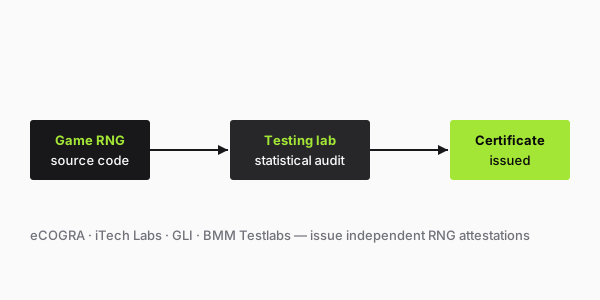
Four names dominate: eCOGRA, iTech Labs, Gaming Laboratories International (GLI) and BMM Testlabs. NMi and QUINEL appear at the higher end of European operators. Each has an accredited testing scope for RNG statistical properties, and each publishes a public register of active certificates.
| Lab | Based in | Common at | Register |
|---|---|---|---|
| eCOGRA | London | UKGC-licensed and higher-tier offshore | Public seal directory |
| iTech Labs | Melbourne | Curaçao and MGA operators | Public certificate list |
| GLI | United States | North America regulated, upper-tier offshore | Public certificate search |
| BMM Testlabs | United States/Australia | Global, land-based and online | Public certificate index |
The lab's location does not change the audit's authority. What matters is whether the specific operator and the specific game build appear on the lab's public register with a live expiry date. That check is the essential step and it is one most reviewers skip.
Two labs sometimes named in offshore marketing carry less weight. TST (Technical Systems Testing) was acquired by GLI a decade ago and the older TST seals should now be current GLI certificates. QUINEL is based in Malta and does credible RNG work but with a smaller footprint. In every case the practical test is the same: does the seal on the operator's page correspond to a live entry on the lab's own register? If it does not, the seal is decorative rather than substantive.
Inside a lab audit
Audit methodologies converge across labs. The RNG source (typically a pseudo-random generator seeded by a hardware entropy source) is submitted with source code and a running instance. The lab runs a battery of statistical tests over very large samples — commonly two hundred million to a billion outcomes. Standard test suites include Diehard, TestU01, and lab-specific extensions. The tests look for uniform distribution, autocorrelation between successive outputs, entropy of the underlying seed, and drift over time.
- Chi-square distribution tests confirm outcomes fall within expected frequencies.
- Serial correlation tests confirm one outcome does not predict the next.
- Runs tests confirm no anomalous streaks of same-value outcomes.
- Entropy tests confirm the underlying seed is unpredictable.
- Payout-percentage audits (optional) confirm the game's stated RTP matches observed data.
The output is a certificate with a validity window (usually one to two years), the tested software name and version, and the scope of tests performed. Many operators publish only the RNG certificate; higher-tier operators publish the payout-percentage report as well, which lets you cross-check the advertised RTP against a lab-observed figure.
RTP, hit frequency and volatility
Return-to-player (RTP) is the long-run expected payback of a game — a slot advertised at 96% RTP returns 96 pence in the pound over millions of spins. It is a distribution statistic, not a session guarantee. A player can lose a full bankroll on a 98% RTP game because the variance around the mean is large.
Two related figures complete the picture. Hit frequency is the fraction of spins that produce any payout at all. Volatility (variance) is the shape of the payout distribution — high-volatility games pay less often but larger; low-volatility games pay more often but smaller. All three figures should be published by a well-run operator, and the RTP and hit-frequency figures should match the testing lab's certificate.
Non gamstop casinos are inconsistent here. Some publish all three figures for every slot. Others show only the marketing headline. If the operator's game info panel shows an RTP number but no source for it, treat it as unverified.
A related pattern to watch for is variant RTP. Modern slot providers ship the same game in multiple RTP configurations — commonly 96%, 94% and 92%. The operator picks which variant to deploy. If the operator's help pages advertise the highest RTP but the deployed variant is the lowest, players are consistently getting less than the marketing claims. The remedy is public disclosure of the deployed variant, which is a UKGC requirement and a discretionary choice offshore. Some offshore operators disclose. Many do not, and reading the actual variant off the game paytable becomes the only route to check.
How to verify a seal is current
- Find the seal on the operator's footer.
- Click it — a legitimate seal links to the lab's public register.
- On the register, search for the operator's brand name.
- Read the current certificate: game/software covered, issue date, expiry date.
- Check the expiry is in the future.
- Check the software version matches what is actually deployed.
If the seal on the footer is a static image with no link, that is a warning. Legitimate seals from eCOGRA, iTech Labs and GLI all support click-through verification. An operator using an image-only seal has either lifted the image from another site or let the certificate lapse without removing the image.
The provably-fair round flow
Provably-fair is a cryptographic protocol for verifiable game outcomes, common on crypto-focused non gamstop casinos and mostly used for simple games (dice, crash, coin-flip, plinko). The mechanics are elegant and worth understanding in detail.
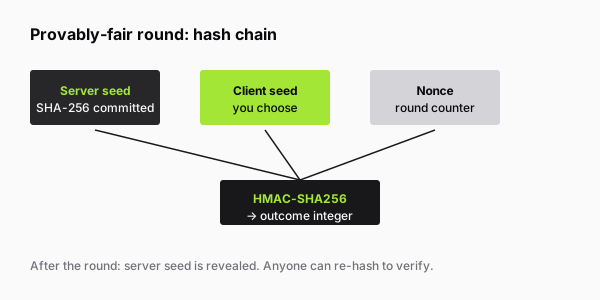
Before you play, the operator generates a random server seed and publishes only its SHA-256 hash. You pick or accept a client seed. The round outcome is computed by HMAC-SHA256 of the server seed with the client seed and a round counter (nonce). After the round the operator reveals the server seed. You can now re-hash it to check it matches the published commitment, and re-compute the HMAC to check it matches the outcome shown. If both checks pass, the round is verifiable.
commitment = SHA256(server_seed)
outcome = HMAC-SHA256(server_seed, client_seed || nonce) mod range
The strength of this protocol is that the operator cannot change the server seed after you have committed a bet, because the hash is already public. And it cannot pick a favourable seed after the fact, because the nonce ties the round to the specific sequence. Well-run provably-fair sites let you rotate the client seed at any time, which is a good habit — a new client seed starts a fresh sequence and prevents the operator from replaying a previously favourable state.
Where provably fair falls short
Provably fair is not a full guarantee of trustworthiness. It guarantees the round was computed correctly given the seeds. It does not guarantee:
- That the odds structure of the game is fair to start with — a provably-fair dice game can still have a 5% house edge.
- That the operator will honour the withdrawal — the payout is a separate step from the round outcome.
- That the operator will not delay the round or refuse to publish the server seed.
- That the game's stated RTP matches the theoretical odds of the payout schedule.
- That the client-seed picker is not subtly biased on the operator side (rare but possible).
Provably fair is best treated as one control among several. A crypto operator that publishes a provably-fair chain and also carries an independent RNG audit gives you two very different guarantees — one per-round cryptographic, one long-run statistical. Neither eliminates the commercial risks that come with a non-UKGC operator.
Live-dealer games and fairness
Live-dealer games (roulette, blackjack, baccarat, game shows) run on physical or filmed equipment rather than an RNG, which means the fairness question shifts. Instead of asking whether the RNG is properly seeded, we ask whether the physical wheel is unbiased, whether the shoe is shuffled correctly, and whether the studio equipment has been certified.
The major studio providers — Evolution, Pragmatic Play Live, Playtech Live, Ezugi — carry their own certifications from GLI and BMM. When an offshore operator streams from a major studio, the fairness of the equipment is inherited from the studio's certification, not built by the operator. What the operator can still get wrong is the payout logic on top of the live stream, and this is where lab audits of the operator's integration matter.
If the live-dealer table on a non-UKGC operator is unbranded, no studio name is visible, and the stream quality is inconsistent, that is a real signal. Unlicensed live equipment is a much larger risk than an unaudited RNG, because the equipment is not standardised and a bias in the wheel is not easily verified by a player.
An additional consideration for live-dealer play is the game-history feature. Well-run operators expose every hand and every spin, including the time-stamps and the outcomes, in a player-accessible history log. This lets a player reconstruct disputes with the operator afterwards. Non gamstop casinos vary here — some inherit the studio's history log (which is generally excellent), others expose only the last twenty-four hours, and a small minority expose nothing at all. Ask before you play: can I see a full history of my sessions on demand? If the answer is no, dispute evidence is going to be very hard to assemble.
UK dispute recourse if a game seems off
If a game outcome looks wrong on a UKGC-licensed operator, the escalation path is clear: complaint to the operator, escalation to the Independent Betting Adjudication Service (IBAS), and reporting to the UK Gambling Commission. On a non-UKGC operator the escalation path is much thinner. The complaint goes to the operator; if unresolved, to the operator's licensing authority (Curaçao GCB, Anjouan, MGA); if unresolved there, effectively nowhere.
This is the practical impact of licensing that all the technical certification in the world does not overcome. A perfectly audited RNG at a Curaçao operator does not give you a UK statutory remedy. If a game's odds appear inconsistent with the certified RTP and the operator refuses to investigate, your only realistic response is to withdraw remaining funds and close the account. This is why we describe fairness at non gamstop casinos as necessary but not sufficient — the technical layer is checkable, but the dispute layer is thin.
UK players sometimes ask whether they should record their session as evidence in case of a dispute. Screen recording is technically possible but rarely useful — the operator will point to its server-side logs as the authoritative record, and those logs are the ones a testing lab audits. The more useful evidence is the transaction record from your payment provider (the deposit, the wager amounts if the operator reports them, the withdrawal request) and any correspondence with support. If a dispute reaches the licensing authority, those records carry more weight than personal screen recordings.
Frequently Asked Questions
Is a certification seal proof of fairness?
A seal indicates the operator submitted specified software to a specified audit within the certificate's validity window. It attests to a snapshot, not to ongoing behaviour. Check the certificate is current and the software version matches what the operator actually runs.
What does RTP actually mean?
Return-to-player is the long-run expected payback of a game over millions of rounds. A 96% RTP slot returns 96 pence per pound wagered on average across a very large sample. It says nothing about session outcomes and is subject to variance around the mean.
How does provably fair verify a round?
The operator commits to a hashed server seed before the round. You supply or accept a client seed. Outcome is HMAC-SHA256 of server seed with client seed and nonce. After the round the server seed is revealed, so you can re-hash to check the commitment and re-compute the outcome.
Which is more trustworthy — audited RTP or provably fair?
They address different failure modes. Audited RTP checks the game's long-run distribution across huge samples. Provably fair checks each individual round cryptographically. Neither is a full guarantee. The strongest operators offer both.
How do I verify a certificate seal is current?
Click through from the seal to the testing lab's public register. Cross-check the operator name, the software version and the certificate expiry against the register entry. A seal that does not click through is a warning.
Can a casino tamper with the game after certification?
In principle yes — certification tests a specific build. Reputable labs periodically re-test and revoke certificates when they find the deployed build has changed materially. But the interval between checks is a window in which a dishonest operator could ship a modified version.
Responsible Gambling
If your gambling has become difficult to control, the correct step is not to look for a "fairer" offshore operator. The NHS operates a National Gambling Clinic. GamCare provides a free helpline on 0808 8020 133. GordonMoody offers residential treatment. BeGambleAware runs the primary UK information portal. GAM-Anon supports family members and partners. These resources are text-mentioned without hyperlinks, in line with our editorial policy for gambling-adjacent pages.
UK statute is on legislation.gov.uk. Background on RNG statistical testing is at Wikipedia. General consumer information is on gov.uk.