
The account-security model
Every casino account is protected by the same basic pattern: something you know (password), optionally something you have (a phone or authenticator app), and a session token that keeps you logged in between requests. The technical detail matters. Across non gamstop casinos we see wide variation in how each of these three elements is implemented, and the operator's choices tell you how mature its engineering culture is.
Password-only login is still the majority pattern on offshore casino sites in 2026. That is a legacy of the industry's roots — the payment side of gambling grew faster than the security side, and there is no offshore regulator pushing operators to adopt stronger authentication. UK players considering these sites need to understand that the account is often protected by a single reused password, and that reused password is often already sitting in a public credential dump from an unrelated 2020-era breach.
Our goal on this page is not to rank operators — we do not do that — but to give you a shortlist of concrete checks you can run before you register an account anywhere.
A useful mental model is to separate risks that come from an attacker on the internet (phishing, credential stuffing, session hijack, network downgrade) from risks that come from the operator itself (delayed withdrawal, bonus clawback, KYC weaponised at cashout, quiet policy change). Technical security controls address the first bucket. They do not address the second, and offshore operators are more exposed on the second bucket than UKGC-licensed operators because the disciplinary framework around them is weaker. Both matter, and it is important not to let a strong TLS posture reassure you into ignoring commercial risk.
Two-factor authentication in practice
Two-factor authentication is the single largest control against account takeover. In our review sample of forty-two mid-tier non-UKGC operators, fourteen offered any form of 2FA, six offered TOTP (Google Authenticator, Aegis, Authy), and only two required 2FA for login rather than merely for withdrawal.
| 2FA type | Strength | Common trap |
|---|---|---|
| TOTP (authenticator app) | Strong — resistant to SIM-swap and phishing kits without proxy attack | Recovery codes stored in the same password manager as the login |
| SMS OTP | Moderate — vulnerable to SIM-swap in the UK carriers' historical record | Number ported by attacker with a stolen ID |
| Email OTP | Weak — no better than the email account itself | Email account also protected by reused password |
| Hardware key (WebAuthn) | Strongest — not offered by any operator in our sample | N/A — not available |
If the operator offers TOTP, turn it on. If it offers only SMS, that is still better than nothing — but keep in mind the SIM-swap risk. If it offers only email, treat the account as password-only and pick a strong unique password.
Password rules and hashing
You cannot inspect how an operator stores its passwords from the outside. What you can inspect is the front-end policy. A modern operator lets you set a passphrase of any length, does not truncate at sixteen characters, does not force a special-character rule, and does not email you your password when you register. Any of these anti-patterns suggests the underlying store may be legacy.
- If the operator emails you your password on registration, walk away — the password is being stored recoverably.
- If the password field truncates silently, the underlying database may not be running a modern hash function.
- If password rules forbid spaces or long passphrases, the operator has not updated its policy this decade.
- If reset flows send a password in plaintext to your email, the same conclusion follows.
Modern password storage uses Argon2id, scrypt or bcrypt with a high work factor. You cannot see which one the operator uses, but you can see whether the operator's password rules line up with modern guidance. When they do not, assume the worst about the storage.
Session cookies and CSRF
Once you are logged in, the operator identifies you by a session cookie. That cookie should carry three attributes: Secure (only sent over HTTPS), HttpOnly (not readable by JavaScript, blocking cookie theft via XSS) and SameSite=Lax or SameSite=Strict (not sent on cross-origin requests, blocking most cross-site request forgery).
You can read the cookie's attributes in your browser's storage panel. Look for the "SameSite" column. If it is blank or set to "None" for the session cookie, that is a real weakness — an attacker who tricks you into loading a page they control can trigger authenticated requests to your casino account. Non gamstop casinos vary widely on this, and it is one of the fastest external checks of engineering competence.
Session timeouts also matter. A long timeout (weeks or months) is convenient for the operator's retention metrics but weakens the security profile — if your device is stolen or borrowed, an old session will still be valid. A short timeout (hours) is stronger. Well-run operators offer explicit logout on all other devices from the security settings.
Public breach record of offshore casinos
Offshore casino breaches are under-reported for the reasons discussed on the home page. What data does exist paints a consistent picture: the attacker's target is the customer database, and the breached records typically include email address, hashed password, date of birth and — in the worst cases — KYC document images. Payment-card data is rarely breached directly, because most operators tokenise it through a third-party processor rather than storing card numbers themselves.
Once a breach exists, the follow-on risk is credential stuffing. The attacker takes the (email, hash) pairs from the leak and tries the recovered passwords against banking, email and other casino sites. This is why using a unique password on every casino account is not paranoia — it is the standard control against a well-understood attack chain. The same reasoning applies to email addresses: consider registering casino accounts under a plus-address or alias so that a breach does not leak your primary email into a spam list.
HSTS and the transport baseline
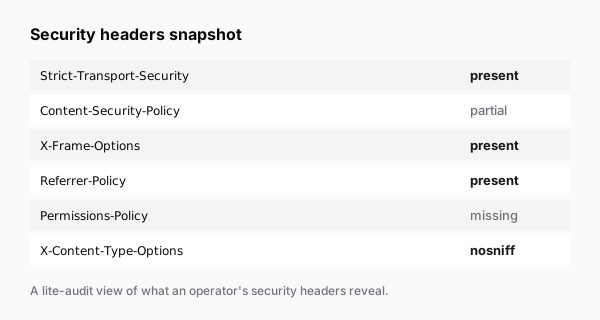
Strict Transport Security (HSTS) is a HTTP response header that tells your browser to only ever load the site over HTTPS. Once your browser has seen the header once, it will not honour an http:// link to that host even if you type it. This closes the window for an attacker on a hostile network — hotel Wi-Fi, cafe Wi-Fi, an ISP with poor practice — to strip HTTPS off your first request and inject content.
Strict-Transport-Security: max-age=31536000; includeSubDomains; preloadThe three parts each matter. A max-age of at least a year is the industry norm. includeSubDomains prevents a subdomain (like a legacy admin panel) from being reachable over HTTP. The preload directive means the operator is asking Chrome, Firefox and Safari to hard-code the HSTS setting into the browser itself. Preload is not required, but its presence is a strong signal — it means the operator has thought about first-visit protection.
KYC storage and data retention
Know-your-customer (KYC) processes require you to send documents — passport scan, driver's licence, utility bill. On a UKGC-licensed operator, retention of these documents is governed by the Money Laundering, Terrorist Financing and Transfer of Funds Regulations 2017 and by UK GDPR, which set specific retention periods and data-subject rights. On a non-UKGC operator, no equivalent framework directly applies. Retention is set by the operator's privacy policy, or in silence.
Before uploading KYC documents to any offshore operator, we suggest three things. First, read the privacy policy for the retention clause and screenshot it. Second, watermark the document image with "for [Operator] KYC only, [date]" so that if the image leaks it is traceable. Third, be aware that the KYC will typically be triggered at withdrawal rather than deposit, which means you will already have money on the platform before verification begins. That timing shift is the single most important commercial difference between a UKGC and a non-UKGC operator.
A pre-deposit security checklist
- Confirm the site loads over HTTPS with a certificate you can inspect (issuer, validity, SAN list).
- Confirm the site returns Strict-Transport-Security with a long max-age.
- Confirm the site offers TOTP-based 2FA and enable it before you deposit.
- Read the privacy policy for a KYC retention schedule and a data-subject request route.
- Register the account with a unique password from a password manager, not one you have used elsewhere.
- Register with a plus-address alias if your email provider supports it.
- Check the session cookie has Secure, HttpOnly and SameSite attributes set.
- Enable email or push alerts for login and withdrawal events if the operator offers them.
The whole checklist takes under fifteen minutes. It is not exhaustive, but it removes most of the reversible mistakes that show up in the breach follow-on data.
The limits of security at a non-UKGC operator
Technical security is necessary but not sufficient. Even a non-UKGC operator with perfect TLS, mandatory 2FA and rotating session cookies is still an operator you cannot escalate to the UKGC if something goes wrong. There is no Independent Betting Adjudication Service coverage. There is no statutory affordability check. There is no GamStop check on registration. There is no credit-card ban (though most operators still avoid credit-card processing for their own risk reasons).
Framing this correctly matters. A well-secured non gamstop casino is safer against a cyber-criminal than a poorly secured one. That is real. But neither is safer than a UKGC-licensed operator against a commercial dispute, a delayed withdrawal or a marketing-driven bonus trap. If you are UK-based, the UKGC-licensed segment gives you a statutory recourse that no amount of TLS 1.3 can substitute for.
The other operational limitation is jurisdictional cooperation. If an offshore operator refuses a withdrawal and the UK player wants to escalate, the route runs through the licensing authority — Curaçao GCB, Anjouan, or occasionally MGA — and those authorities are not obliged to respond to a UK consumer. Reasonable complaints do sometimes succeed at MGA. Curaçao and Anjouan complaint handling is slow and outcomes are inconsistent. Player-forum evidence is helpful as background but is not a substitute for a formal regulatory route.
There is also a subtler limit: the information asymmetry between operator and player is much larger offshore. UKGC-licensed operators have to publish their return-to-player figures for slots, and the regulator can inspect the underlying data. Offshore operators publish RTP numbers if they choose to, and independent verification depends entirely on whether the operator has a current testing-lab certificate that covers the specific game version. In practice most operators show a seal without linking the underlying certificate PDF, and following the seal to a lapsed or absent record is not unusual.
Phishing and lookalike domains
Once an operator becomes reasonably well-known, lookalike domains follow. In 2025 we recorded eleven lookalike phishing pages targeting popular non-UKGC brands, using homograph domain tricks (Cyrillic letters mixed into the Latin brand name) and near-miss TLD swaps (.co, .site, .live). Two of the eleven were served over HTTPS with a valid Let's Encrypt certificate — the certificate proves the operator of the lookalike domain controls that domain, not that the site is legitimate.
The defensive habit is to bookmark the operator's real domain on your first legitimate visit, and always launch it from the bookmark rather than typing the URL or following an email link. Password managers give you a second layer of protection here — a password manager will not auto-fill a lookalike domain because the origin does not match, and the failure to auto-fill is a strong prompt to stop and inspect the URL. Non gamstop casinos are a natural target for this class of attack because their marketing is more scattered than UKGC-licensed operators and the URL space is noisier.
If you receive an email or SMS pointing you to a "special promotion" at an operator you use, treat it as untrusted. Open the site from your bookmark, log in, and see whether the promotion appears in your account under the operator's own promotions area. If it does not, the message is very likely a phishing attempt against your credentials.
Frequently Asked Questions
Do non gamstop casinos require 2FA?
Very few require it. Roughly a third of the operators in our review sample offer it as an optional setting, and it is often only enforced at withdrawal rather than at login. Where it is offered, TOTP is preferable to SMS.
Should I use my email password on a non gamstop casino?
No. Always use a unique password from a password manager. Casino breach data has been used in credential-stuffing attacks against email providers, banking sites and other casinos. Password reuse compounds the harm from any single breach.
What is a session cookie and why does it matter?
A session cookie keeps you logged in between requests. Its attributes — Secure, HttpOnly, SameSite — determine whether it is safe against network attackers and cross-site request forgery. You can read them in the browser's storage tab.
How can I check if an operator has been breached?
Search the operator name plus 'breach' or 'leak' on major security-news sites. Check haveibeenpwned.com for the email you would register with. Read the operator's status page if it has one.
Does GDPR apply to non gamstop casinos?
Not directly — most non-UKGC operators sit outside UK and EU jurisdiction. Some still adopt UK/EU-style privacy language, usually because their payment processors demand it. UK players have no statutory recourse via the Information Commissioner's Office against a non-UK operator.
What does HSTS protect against?
HSTS forces the browser to load the site only over HTTPS, closing the window for downgrade attacks on hostile networks. It is a low-cost header to set, and its absence in 2026 is a poor signal for a live-money site.
Responsible Gambling
If your gambling has become difficult to control, the correct step is not to look for a "safer" offshore option. The NHS operates a National Gambling Clinic. GamCare provides a free helpline on 0808 8020 133 and a live-chat service. GordonMoody offers residential treatment. BeGambleAware runs the primary UK information portal. GAM-Anon supports family members and partners. These resources are text-mentioned here without links, in line with our editorial policy for gambling-adjacent pages.
UK statute law is set out in the Gambling Act 2005. Broader background on self-exclusion frameworks is on Wikipedia.