
SSL vs TLS terminology
The gambling market talks about "SSL encryption" out of habit. In 2026 the protocol in use is TLS — Transport Layer Security. SSL 2.0 (1995) and SSL 3.0 (1996) were the earlier versions from Netscape. SSL 3.0 was deprecated after the POODLE attack in 2014. TLS 1.0 followed in 1999, TLS 1.1 in 2006, TLS 1.2 in 2008 and TLS 1.3 in 2018. When an operator's marketing page talks about "128-bit SSL", read it as TLS with an AES-128 cipher. When you look at non gamstop casinos for their transport security, the questions to ask are about TLS, not the retired SSL family.
The reason it matters is that legacy language sometimes hides legacy configuration. If a casino site still permits TLS 1.0 or 1.1 in its handshake — which is testable from outside without touching an account — that is a real weakness. Browsers no longer negotiate those versions, but the server offering them is a signal of a stale operations team.
The other habitual confusion in casino marketing is the phrase "military-grade encryption". The phrase is not technical. In practice it usually means AES-256, which is a solid symmetric cipher used across banking, government and commerce. AES-128 is also acceptable and often preferred on mobile because it runs faster. Whether the site is running AES-128 or AES-256 does not meaningfully change the security of your session against a network attacker. What matters is that some flavour of AES-GCM or ChaCha20-Poly1305 is in use, that the key exchange is ephemeral, and that the certificate chain validates. When you read a marketing page that talks about encryption strength, treat those numbers as background — they are not the questions on which the transport security actually turns.
TLS 1.3 in detail
TLS 1.3 is the current standard. It is the first version of the protocol that removed almost the entire legacy cipher pantheon rather than adding to it. Key exchange is limited to ephemeral Diffie-Hellman variants (ECDHE, DHE), which gives forward secrecy for free. Symmetric encryption is limited to AEAD ciphers (AES-GCM, ChaCha20-Poly1305), which combine confidentiality and integrity in one step. Static-RSA key exchange, CBC-mode ciphers and RC4 are all gone.
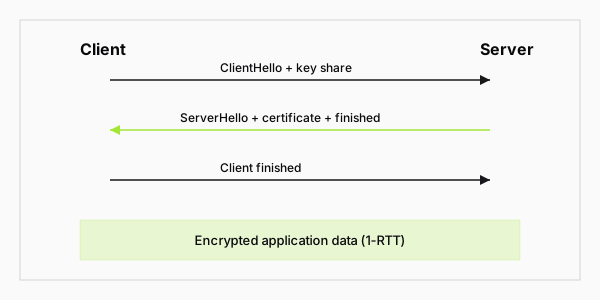
The handshake is compressed from two round trips to one. This is why enabling 1.3 on a casino site improves the first-page paint speed on mobile, and is one commercial reason offshore operators moved to it more quickly than expected. There is also a zero-round-trip (0-RTT) mode, which trades a small replay-attack window for even faster reconnects. Well-configured casino sites disable 0-RTT because the replay tolerance is not appropriate for financial requests.
How do you know whether the site you are on is using 1.3? Chrome's DevTools Security tab reports "TLS 1.3, X25519, AES_128_GCM" or similar. Firefox does the same. If it says "TLS 1.2" only, the operator has not moved yet.
Cipher suites you should see
A cipher suite is the tuple of algorithms negotiated between browser and server. Under TLS 1.3 there are only five defined suites, all AEAD-based, all with ECDHE key exchange. The three you actually see are TLS_AES_128_GCM_SHA256, TLS_AES_256_GCM_SHA384 and TLS_CHACHA20_POLY1305_SHA256.
| Cipher suite | Strength | Notes |
|---|---|---|
| TLS_AES_128_GCM_SHA256 | Strong | Default on Chrome, fast on server hardware with AES-NI |
| TLS_AES_256_GCM_SHA384 | Strong | Preferred on desktop where extra margin is cheap |
| TLS_CHACHA20_POLY1305_SHA256 | Strong | Preferred on mobile where AES-NI is absent |
| TLS_RSA_WITH_AES_128_CBC_SHA (1.2 only) | Legacy | Should not be offered by a live-money site |
| TLS_RSA_WITH_RC4_128_SHA (1.2 only) | Broken | Do not proceed |
Under TLS 1.2, cipher choice matters much more because the historical zoo of legacy suites still exists. If a casino site accepts 1.2 you want to see ECDHE-RSA or ECDHE-ECDSA with AES-GCM. Anything CBC-mode is old. Anything RC4 is broken. External SSL testers (see below) grade this automatically.
The other TLS 1.2 setting worth knowing about is server-side cipher ordering. A well-configured server pins the negotiation so that the strongest suite the client supports is chosen, rather than deferring to the client's preference. Non gamstop casinos vary here — some ship a modern configuration and some inherit whatever default came with their web server distribution. Qualys will flag this in its report. In 2026 there is no reason for a live-money site to be running an old default; the current Mozilla server-side TLS guidelines are a well-maintained reference and take an operator's engineering team an afternoon to apply.
Anatomy of a casino certificate
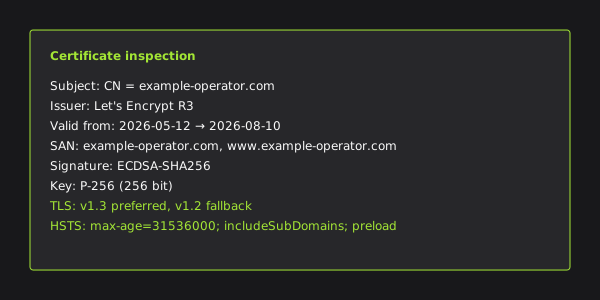
An X.509 certificate binds a public key to a domain name via a signature from a trusted authority. On a live-money site there are five fields that matter for a first-pass read.
- Subject Common Name and Subject Alternative Names (SAN). The exact domain and subdomains the certificate covers.
- Issuer. The certificate authority that signed it — Let's Encrypt, Sectigo, DigiCert, GoDaddy, Google Trust Services.
- Validity window. Not-before and not-after dates. Under 398 days in 2026.
- Signature algorithm. ECDSA-SHA256 or RSA-SHA256. SHA-1 must not appear.
- Public key algorithm and size. P-256 or P-384 ECDSA, or 2048-bit RSA at minimum.
DV, OV and EV validation
Certificates come in three validation levels. Domain-validated (DV) proves the operator controls the domain — the fastest and cheapest to issue, and by far the most common for casino sites in 2026. Organisation-validated (OV) requires the CA to verify the operator's registered business details. Extended-validation (EV) requires an in-person or documentary check of the operator company. Most non gamstop casinos use DV certificates because they issue automatically, rotate on ninety-day cycles and cost nothing.
The security guarantee is identical across the three levels — the encryption is the same. The verification story differs. An EV certificate historically caused the browser to show the operator's company name in green in the address bar. That green treatment was removed from Chrome and Firefox in 2019 because studies found it did not measurably help users. So today the EV vs OV vs DV distinction is not a user-facing signal at all. It is a background check that you can read in the certificate details, and its main value on a casino site is confirming that a real named company is behind the brand.
Mixed content on the payment page
Mixed content — HTTP sub-resources loaded on an HTTPS page — is the fastest way an operator's TLS story falls apart. The payment page is the highest-risk place for mixed content, because a script served over HTTP can be modified in transit to steal the card number as you type it. All modern browsers block "active" mixed content (scripts, iframes) automatically, but "passive" mixed content (images, some fetch calls) can still creep through as an "insecure" indicator without the browser refusing to load.
- Open the payment page while logged in.
- Open developer tools and go to the Network tab.
- Filter for "http:" in the URL.
- Any hit here is a mixed-content problem worth flagging to the operator.
Well-run non gamstop casinos have clean payment pages. Smaller white-label sites often carry an old marketing pixel or an outdated live-chat widget over HTTP, and the browser's mixed-content warning is easy to miss on a busy page.
There is a related and subtler risk on payment pages: third-party scripts served over HTTPS but from domains that are not the operator's. Analytics scripts, tag managers, live-chat vendors and A/B-testing tools all run in the operator's origin, which means a compromise at any of those third parties translates to a compromise of the payment page. This is the pattern behind most of the well-known e-commerce card-skimming incidents of the past few years. The defensive control is a strong Content-Security-Policy that whitelists which script origins are allowed to run, and offshore casinos vary widely on whether they have taken that step.
Inspecting a certificate in your browser
Every mainstream browser exposes certificate details in a way you can read in under a minute.
- Chrome or Edge: click the padlock, choose "Connection is secure", then "Certificate is valid". This opens the OS certificate dialogue with the full X.509.
- Firefox: click the padlock, choose "Connection secure → More Information → View Certificate". This opens Firefox's own certificate viewer at about:certificate.
- Safari: click the padlock, choose "Show Certificate". Expand "Details" for the full data.
Read the issuer, validity, signature algorithm and SAN list. Cross-check the SAN list against the domain you actually visited — a mismatch is a genuine failure. Cross-check the validity end date against today — long-past renewal is a signal of neglect. Cross-check the signature algorithm — SHA-1 should not appear on a live-money site in 2026.
External SSL tests (Qualys, Mozilla)
Two external tools do this work automatically. Qualys SSL Labs (ssllabs.com) grades the site from A+ to F based on protocol support, cipher choice, certificate quality and known configuration bugs (Heartbleed, ROBOT, BEAST). It reports the specific handshakes the server offers and flags legacy protocol acceptance. Mozilla Observatory (observatory.mozilla.org) tests headers as well as TLS and gives a score plus a checklist.
A grade of A or better from Qualys is what you want to see on a live-money site. Anything below B is a concern; anything F is a break — most commonly caused by an expired certificate, a weak cipher-only configuration, or an SSL 3.0 acceptance that no operator should still have in 2026.
These tools are free, take about a minute per site, and do not require any account. There is no reason to skip them before you deposit at an operator you have not used before.
A word on what these tools do not tell you. They test the transport layer and the response headers. They cannot audit the application layer, the game engine, the payment integration or the operator's back-office. An A+ on Qualys plus an A+ on Observatory is a good sign about the operator's operations culture, but it is not a certificate of solvency or dispute practice. Non gamstop casinos in particular can score well on external transport tests while carrying commercial risk on the withdrawal side. Read the scores as one input, alongside the certification pages we cover on non gamstop casino fair play and the account controls on non gamstop casino security.
Renewal cadence and short certificates
Certificate lifetimes have shortened over the last decade. In 2018 the industry accepted three-year certificates. In 2020 the maximum dropped to 398 days. In 2026 the CA/Browser Forum has agreed a phased reduction toward 47 days by 2029. Let's Encrypt has issued 90-day certificates since inception. Short lifetimes limit the damage from key compromise and force operators to automate renewal.
What this means at a casino site is that the current certificate should be well within its validity window at any moment. If you visit and find a certificate with three days left, either automation is broken or the operator does renewal by hand — neither is a comforting sign. Well-run operators are so far inside the window that the not-after date is months away every time you look.
Another test is to check the Certificate Transparency logs. Every publicly-trusted certificate issued in the last decade is written to at least two CT logs, and there are free explorers (crt.sh, censys.io) that let you look up all certificates ever issued for a domain. A single active certificate at a time is the healthy pattern. Dozens of overlapping certificates across many subdomains suggests either a large operational footprint (fine) or a series of failed automation attempts (a signal). CT logs also let you catch mis-issuance — if a certificate has been issued for your operator's domain by a CA the operator does not use, that is a genuine incident.
The overall point is that transport security at a non gamstop casino is checkable from the outside with tools that are freely available, take minutes to run, and give you a much clearer picture than the marketing pages of the operator itself. It is not a full audit; it is a first-pass filter. If the transport layer fails the checks in this page, no other engineering claim by the operator is likely to hold up either — and the corollary is that a transport layer that passes is a necessary condition rather than a sufficient one.
Frequently Asked Questions
Is SSL the same as TLS?
In modern use they are used interchangeably, but strictly SSL is the deprecated predecessor. All current "SSL" on the web is really TLS 1.2 or TLS 1.3. If a casino homepage says "256-bit SSL", read it as TLS with an AES-256 cipher.
What cipher suite should a casino be using?
Under TLS 1.3, expect AES-128-GCM, AES-256-GCM or ChaCha20-Poly1305 with an ECDHE key exchange. Under TLS 1.2, expect ECDHE-RSA or ECDHE-ECDSA with AES-GCM. Anything CBC-mode or RC4 is legacy.
How do I inspect a casino certificate?
Click the padlock in your browser and choose Certificate. Read the issuer, the SAN list, the validity window and the signature algorithm. Cross-check the SAN list against the domain you actually visited.
Does a Let's Encrypt certificate mean the site is untrustworthy?
No. Let's Encrypt is a legitimate free certificate authority and its DV certificates provide the same encryption as paid CAs. The CA choice is not itself a trust signal — configuration, headers and application behaviour are.
What is mixed content and why does it matter?
Mixed content is HTTP resources loaded on an HTTPS page. On a payment page it is dangerous — an attacker on the network can modify a mixed-content script and inject a form skimmer that steals card data as you type.
Can I trust a green padlock?
Only in the narrow sense that the transport is encrypted. HTTPS says nothing about the operator's solvency, licence conditions, KYC handling or dispute practice. A perfect padlock does not stop a delayed withdrawal.
Responsible Gambling
If your gambling has become difficult to control, the correct step is not to search for a "safer" offshore operator. The NHS operates a National Gambling Clinic. GamCare provides a free helpline on 0808 8020 133. GordonMoody offers residential treatment. BeGambleAware runs the primary UK information portal. GAM-Anon supports family members. These resources are text-mentioned here without hyperlinks, in line with our editorial policy for gambling-adjacent pages.
UK statute law is on legislation.gov.uk. Background context on TLS itself is on Wikipedia. General consumer information sits on gov.uk.